Welcome to Check Your Mode

The all-inclusive, ever-changing, and uncomfortably flexible guide to all things music in the 2010's.

Tuesday, March 8, 2011

Sic Alps - Napa Asylum: B+

The concept of a lo-fi double album fascinates me. The idea of making a sprawling LP of scrappy garage rock tunes that only barely clock in at two minutes seems to me like the biggest musical oxymoron since The Ramones started singing about Nazis over major chords and “hey ho”’s. Napa Asylum, the third album from San Francisco group Sic Alps, has often been analogized as the garage rock Exile on Main St., and those comparisons are warranted. Napa Asylum is a surprisingly consistent collection of ramshackle love songs, and the first lo-fi album that can be safely called an “experience record.”

One might also be reminded of London Calling when I describe Napa Asylum as a sprawling record, but Sic Alps’s work on their album is far from it, in form. Where The Clash used their record space to experiment with different genres, Sic Alps strictly play simple rock songs that are most similar in style and fidelity to The Velvet Underground. Never on Napa Asylum does the group stray from that line. In fact, due to the brevity of most of the songs on the album, Sic Alps usually keep you engaged by implementing one indelible hook per track. Sometimes, it’s the annoying repetition of “eat” in “Eat Happy” or the playful guitar pull-offs in “Zeppo Epp.” It’s a risky strategy, as it would be nearly impossible to defend against arguments that claim the album’s songs are one-dimensional, but, more often than not, Napa Asylum is entertaining as it progresses in sound from acoustic to distorted to ambient to acoustic, again.

Less than a handful of Napa Asylum’s songs run over three minutes long, the first of which arrives ten tracks into the album. One would assume these few songs would be the album’s highlights, as the group would have more time to develop more than just a hook, but they are no more affecting than the rest of Napa Asylum. “The First White Man To Touch California Soil” is probably the most realized track of the bunch, even featuring a guitar solo within its ragged bluster, but “Ball of Fame,” a cute ditty in which singer, Mike Donovan, warns a girl she “better play the game,” is just as memorable, and, at just over a minute, is little more than a third of “First Man”’s track length.

Ultimately, I may enjoy the concept of Napa Asylum better than the actual music. All the album’s tunes are great, but its source material can seem overwrought at times, and the short track lengths occasionally turn promising gems into transitional missed opportunities. Still, it’s hard to complain about an album as reliable as Napa Asylum. It’s far from revolutionary, but it’s one of the most replayable lo-fi albums I’ve ever heard. I may have my qualms, but I would not mind if Sic Alps kept releasing workhorses like Napa Asylum that can keep you satisfied at a low production cost.


Share/Bookmark

Monday, March 7, 2011

Nicolas Jaar - Space Is Only Noise: B+

On his debut album, New York electronic artist, Nicolas Jaar, finds himself in a stylistic bind. No matter how effectively he tries to split the difference between slinking dance music and minimalist techno, he cannot end up drawing comparisons to either Matthew Dear for the former or James Blake for the latter. On songs like “Keep Me There” and “Problems With the Sun,” Jaar employs a deep and bubbly vibrato that has significant interest value, but one that reminds me far too much of Matthew Dear’s work on his 2010 album, Black City. Similarly, the slower songs of Space Is Only Noise, like opener, “Colomb,” are spare with dabblings of handclaps and light bass, but I cannot listen to them and not think of the shy dubstep of James Blake’s newest self-titled release. It also doesn’t help that Jaar heavily auto-tunes his voice on “Colomb,” which only draws more attention to Blake’s use of it on his album, which was employed to significantly greater effect.

Space Is Only Noise is a very good album, but what holds it back from being excellent, aside from that originality issue, is that Jaar utilizes a certain restraint that tempers the album’s material to the point where the most rambunctious numbers are seriously lacking in the exploitation of their inherent creepiness. “Space Is Only Noise If You Can See” is the album’s focal point, and rightfully so, as it is the only song in which we see Jaar let loose, railing off non sequiturs in that Dear-like intonation like “Replace the word ‘space’ with ‘drink’ and forget it/Space is only noise if you can see.” “Grab a calculator and fix yourself” is such a gloriously random line in the song, and Jaar does not waste it by diluting the listener’s singular mood with calming falling-sea-shells-on-a-window-sill percussion that was characteristic of Pantha du Prince’s Black Noise, as he does on much of Space Is Only Noise. Jaar clearly knows what he’s doing here, but he needs to figure out how that “what” is going to be different from that of the formative electronic artists making music these days. Space Is Only Noise is a good start, but one that indicates some clear space for improvement. And if that space is only noise, then Jaar can just tune my critiques out… but that’s only if he can see them, and I’m not sure that he can. God I hate when I get punny.


Share/Bookmark

East River Pipe - We Live in Rented Rooms: B-

So, apparently, the guy who is East River Pipe, Fred Cornog, has been building a music career by making one-off albums in the basement studio of his New Jersey home and giving them to a label, whereupon they are released to the public and the man has no obligation to leave his family or his actual occupation to tour or do any promotional work, whatsoever. With that knowledge in mind, We Live in Rented Rooms, Cornog’s first album in five years, pretty much sounds like it came from a guy who makes one-off albums in a basement in New Jersey between stints at an actual work place; his newest is passive, mundane, and painfully boring.

We Live in Rented Rooms is a near spitting image of the vaguely electronic hipster pop that Eels has been making for more than a decade, except Cornog has an even more voracious penchant for awkward lyrics. In fact, the only thing that makes the album stand out at all is the fact that Cornog feels the need to accompany his bland folk songs with lyrical concepts that do not fit the material at all. Album opener, “Backroom Deals” attempts to simplify the government’s reaction to the financial crisis through the repetition of the title in only the most vaporous way. Not only does it come off as shallow (which I can’t necessarily blame him for, as nothing really rhymes with “no-credit default swaps”), but it doesn’t even sound like Cornog believes what he’s saying, as if he’d just walked into a studio and figured he’d make something up while he strummed his gui-tar for a couple minutes.

“Conman” has similar political aspirations. It’s difficult to tell what the point Cornog’s trying to make when he sings, “The priest’s making love on his knees,” but it’s just as well, as I come out of the song not giving a rat’s ass as to what it could possibly mean, anyway.

Such is the plight of We Live in Rented Rooms. If it weren’t for Cornog’s numerous lyrical gaffes, the album would be a pointless listen. At least it’s a little interesting to see how the guy screws up the revenge ballad concept of “Payback Time” (He’s cacophonous right out the gate when he leads off with the line “Yeah, I saw you with the commandant”) and the resemblance of “Tommy Made a Movie” to a minor-key “Tommy Can You Here Me?” has a fleeting entertainment value, but most of We Live in Rented Rooms sounds half-assed and complacent. I would say that Cornog shouldn’t quit his day job, but he seems to have a much better grasp of his artistic longevity than I do.


Share/Bookmark

Sunday, March 6, 2011

Omnium Gatherum - New World Shadows: B+ / MyGrain - MyGrain: B+


"Everfields"                                                                            "Shadow People"

Don’t get the wrong idea. I’m not so negligent of metal that I just slap the same grade on pairs of metal albums and put them out in double reviews. The reason why I grouped the new albums by Ulcerate and Mitochondrion was because the two albums were quite similar, in both general sound and my disdain for them. I cannot help but notice clear similarities between the new albums by Omnium Gatherum and MyGrain, as well. Both are solid albums by groups hailing from Finland, the melodic death metal capital of the world. They are worthy additions to both groups’ respective discographies, even though they don’t necessarily progress the genre further.

Of the two, Omnium Gatherum is more indebted to the style of traditional melodic death metal. Produced by Dan Swanö, the man who helmed the boards for Barren Earth’s classic Curse of The Red River, New World Shadows displays many of the signifiers that have characterized the efforts of various melodic death metal acts in at least the past year. Growling vocals laced with harmonious guitar lines and atmospheric synthesizers are all over New World Shadows, but Omnium Gatherum make some attempt to diverge themselves from the genre that has experienced an explosion in productivity over the past couple years. ­­­­­­Markus Vanhalla's guitar parts are particularly euphoric, whether as songs’ aural decoration or main riff. However, as New World Shadows progresses, the similarities between it and Curse of The Red River become more apparent. On both albums, the first and last songs are the longest, and, like Red River’s title track, New World Shadows’s opener, “Everfields”, diverges into a Nordic folk jamboree before continuing with the metal that dominates their album. Both albums frequently delve into the balladic, but Omnium Gatherum shoehorn slow parts into places where they don’t comfortably fit, as if they see the melodic aspect of their sound as a necessity rather than a logical musical progression. Also, New World Shadows might be the first metal album of which I prefer the growled vocals to the clean ones. The actual singing that takes place in “Deep Cold” and the title track sounds laughably forced, reaching Trans Siberian Orchestra levels of cheese. New World Shadows is a good album, but its trivialities may be a bore to those who are already familiar with their genre of music.

MyGrain’s third album does not reach the highs or lows of New World Shadows. The band has an unfortunate knack for choosing awful song titles (“A Clockwork Apocalypse”? “Shadow People”? Really, guys?), but they perform their brand of melodic death metal at a consistently enjoyable pace. MyGrain is interesting in that its sound both strives for something more aggressive, but, through the band’s choruses and vocal techniques, sound like an attempt to reach the mainstream. For this reason, I see MyGrain as an album that takes much of its influence from modern American metal. The band’s clean vocals sound like Atreyu’s Brandon Saller and the faint drum machine blips that begin “Eye of the Void” sound like Disturbed’s “Indestructible”. Still, there is one band that I cannot help but link MyGrain to, and that is Trivium. Most of the clean vocals on MyGrain sound like the adolescent gruff of Matt Heafy. The screaming often sounds like the band circa Shogun and the “this mortal coil” line in “Shadow People” could have been written by the band for The Crusade. Now, I’m aware that “Atreyu”, “Disturbed” and “The Crusade-era Trivium” are all loaded words, but MyGrain has the clout to make these influences push their music in more mainstream directions without sacrificing their authenticity. With their self-titled album, MyGrain have made a good iteration of the Trivium sound, which is something that not even Trivium can wholly lay claim to.

Share/Bookmark

Thursday, March 3, 2011

Motörhead - The Wörld Is Yours: A-


The people who claim to have figured out the “Motörhead formula” by saying that they simply release the same song over and over are naïve and ignorant. There is a very definite formula for why and how Motörhead manages to come up with albums every couple of years that sound starkly similar, but it’s not because they fucking thought “Hey mates! Let’s just rewrite the same song for each album we release!” No, you fools! It’s not that simple! The truth is Motörhead albums have all sounded extremely similar since the early nineties, because each new album up to and including this point has been a random collection of songs that were recorded in a massive studio session in 1991.

Exhausted and frustrated with the process of going to a studio between tours to record a new album, of which sometimes there were two released in two consecutive years, frontman Lemmy Kilmister came up with the ingenious plan to, for a full month, record as many songs as possible and to release ten to eleven of them every two to three years. In December of 1991, Lemmy, guitarist Phil “Zoomer” Campbell and Drummer Mickey Dee walked into Music Grinder Studios in Los Angeles and emerged on January 1st 1992 with 3,129 new songs. With the exception of the independently recorded Inferno, each new Motörhead album sounds similar to the last, because all of them have been produced by the same producer with the same equipment at around the same time so that Lemmy’s mind could be eased in between tours.

So essentially, what we have with The Wörld Is Yours and every other Motörhead album that has been released since 1991, is the very definition of a grab bag. As you can infer, the quality of a Motörhead album has not depended on the band’s lyrics, instrumentation or mood for decades. Now that you know the ultimate Motörhead secret, you can see that what makes a Motörhead album good at this point is the track sequencing; does this collection of songs sound good in this particular order?

For 2008’s Motörizer, this was, for the most part, not the case, for 2002’s Hammered, this was most assuredly not the case and, for 1996’s Snake Bite Love, this was hell-to-the-no not the case. But, for 2011’s The Wörld Is Yours, this is the case. Now, I could go into detail about why I think The Wörld Is Yours is good and why I believe that it’s the best Motörhead album since 2004’s Inferno. I could say that I like the stabs of guitar chords in “Outlaw”, that I like some of the lyrics in “Get Back in Line” like “Good things come to those who wait/But these days most things suck” or “If you think Jesus saves/Get back in line”, but come on. This is a motherfucking Motörhead album we’re talking about, here. Do you know when the last Motörhead album is going to come out? 2324! I’m doing you a favor by not giving you more details! I’ll leave that to the historian in 2350 that has to create the archive of the entire musical career of Motörhead in a fifty two-volume book series. Just know that The Wörld Is Yours is excellent, listen to it if you wish, and hold tight for another couple years when, like the Disney Vault, ten more songs will be released from the “Music Grinder” sessions.

You must guard The Secret of Motörhead with your life. It seems easy now, but things are going to get really heated in a couple decades, when people begin to wonder how Lemmy can release ten, twenty, then hundreds of posthumous albums. Motörhead albums are, essentially, compilations, now, and that’s a dangerous prospect with a scope of which I don’t think even Lemmy, understands. Many have called him the cockroach of rock and roll; a man who, no matter what, will still be coming out with new material. I’m here to tell you that, in three hundred years, Lemmy’s going to wish that he had the brief longevity of a cockroach. In the case of The Wörld Is Yours, the Motörhead formula has served the group and humanity well, but its repercussions are farther-reaching than you or I will ever see come to fruition in our lifetimes. I pray that civilization will find a way to outmaneuver the Pandora’s box that Motörhead opened that fateful December in 1991. And, now that you know, you have just as much responsibility as I do to surreptitiously warn others of the catastrophe that is to befall us all.


Share/Bookmark

Wednesday, March 2, 2011

The Go! Team- Rolling Blackouts: A-


It should be no surprise to those familiar with the sound of UK indie electronicists, The Go! Team, that their third album, Rolling Blackouts, does little to diverge from the sound they established with their debut, 2004’s Thunder, Lightning Strike. The group still sounds like the best high school pep band you could ever hope for, with the zeal of the group’s many singers ceaseless across the album’s forty minutes. It’s almost redundant to say that they sound like blacksploitation-era funk and giddy pop punk, because of how consistent that sound’s been with them over the years, but I want do so to make sure that it’s taken note of that that sound can be applied to every song on Rolling Blackouts. But consistency does not an excellent album make. What makes Rolling Blackouts exceedingly enjoyable is that The Go! Team manage to dig into the elements that have made them distinct and enrich them to create an album that seems like a subtle but logical next step in their musical career.

With Rolling Blackouts, The Go! Team makes the right decision to give their sound depth and variance. All of Rolling Blackouts is energetic and vibrant, but each of its tracks conveys a different mood. Songs like “T.O.R.N.A.D.O.” and “Back Like 8 Track” are very much indebted to their seven-year-old style, but tracks like “The Running Range” and “Secretary Song” add a slightly slower dynamic while still maintaining that glassy-eyed aesthetic. “Apollo Throwdown” is also a traditional Go! Team gem, but its beat is buoyed by harps and a swooning orchestra, tempering the song and giving it a more mature sensibility. The ready-for-the-marching-band instrumental, “Bust-Out Brigade”, builds with the ardor of RJD2’s “Let There Be Horns” and the chorus of “Ready To Go Steady” recalls the emotional succinctness of Shonen Knife’s Japanese pop.

The two best songs of Rolling Blackouts are the Bethany Cosentino (of Best Coast fame) collaboration, “Buy Nothing Day”, and the mostly instrumental “Yosemite Theme”. While the former aligns itself with that Go! Team sound, the latter is the most radical distillation of the group’s newfound richness. Beginning with a saintly horn line and lightly picked guitar, the track weaves in instruments new to the Go! Team pallet like banjo and harmonica into something that actually sounds like the soundtrack to a kickass Yosemite Park documentary. With the mixture of these elements and the blasting percussion characteristic of every track on Rolling Blackouts, I am reminded of Race For Your Life, Charlie Brown, a film that, for me, turned the wilderness into something not just pretty, but cool and fun.

“Buy Nothing Day” should not be underestimated, though, because it features Rolling Blackouts’s best melodies. Cosentino’s voice, which has already proven itself formidable on her own debut, fits in well with The Go! Team’s vastly detailed production flourishes. It’s Rolling Blackout’s most spare track, with only orchestration added to the standard guitar/drums/bass combination of most rock bands, and is all the better for it.

The success of “Buy Nothing Day” is representative of the success of all of Rolling Blackouts. Some may see the group’s choice to tone down their bombast as a watering down of what makes them good, but I see it as a conscious realization by the group that they cannot keep releasing the same album year after year. Nevertheless, it’s hard to see people who enjoyed Thunder, Lightning Strike abhorring Rolling Blackouts, as its changes are not drastic or immediately apparent. What Rolling Blackouts proves is that a group that simply digs deeper into what they’re good at can be just as rewarding as a radical change or a stubborn repetition.

Share/Bookmark

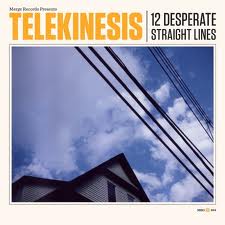
Telekinesis - 12 Desperate Straight Lines: B+

The focal point of Telekinesis’s second album is not auteur Michael Benjamin Lerner’s voice, lyrics, guitar-playing or even songwriting. What makes 12 Desperate Lines a supremely listenable album despite the fact that it is, essentially, an album of indie pop retreads in the vein of Fountains of Wayne is the bass. Within the album’s first thirty seconds, its presence is made obvious when a propulsive if not virtuosic bassline forces Lerner’s voice and guitar strums to the backseat in the album opener, “You Turn Clear in the Sun”. Throughout, the bass of 12 Desperate Lines keeps things interesting and flowing at a brisk pace. Its authority over the mix can range from the supportive (“I Got You”) to the decorative (“Fever Chill”) to the ubiquitous (album highlights “I Cannot Love You” and “Please Ask For Help”). It’s an essential aspect of 12 Desperate Straight Lines that, from time to time, lifts the craft of entire songs above the mire of monotony.

The only other notable aspect of 12 Desperate Lines is Lerner’s lyrical turn in “You Turn Clear in the Sun”, which takes a “turn the other cheek” attitude to a breakup song. With simple and concise diction, Lerner makes his ruminations sound both cute and revelatory. “I could sit and wonder/’Bout where I went wrong/Or I can go out on Friday/And try to have fun”, he muses over light percussion and that rich bass. It ‘s a naively simple mindset to express in a song, but one that I cannot say I’ve heard on any record in recent memory. Lerner spends the song killing that estranged ex with kindness (hoping her next lover treats her right, writing down the fond memories they had together), until the listener is unquestionably on his side when he inquires to that former lover, “Now was it you or was it me?”.

Other than that, 12 Desperate Lines’s bass presence is the best thing it’s got going for it. In that regard, it’s surprisingly unique, but I wouldn’t blame you if you avoided it all but “You Turn Clear In The Sun”.


Share/Bookmark

Monday, February 28, 2011

Earth - Angels of Darkness, Demons of Light Pt. 1: B+ / Minks - By the Hedge: B-


"Father Midnight"                                                                       "Indian Ocean"

Sometimes, originality can be really pesky. Sometimes, you’d just rather listen to an album and not have to worry about whether the artist playing it is going to influence generations of musicians or even whether you’re going to remember it a month from now. Sometimes, there’s just music that you want to indulge in for a singular mood and Hell to all else if you just want to hear background music for forty or so minutes. The music by New York duo, Minks, can be safely considered indie pop and the music by Washington quartet, Earth, can be safely considered drone. Both groups have released these types of “mood” records; pieces of music that are not meant to be enjoyed for individual songs, but for the stringently monolithic moods they represent.

Earth have been playing music since 1990. Angels of Darkness, Demons of Light Pt. 1 is somewhere around their eleventh album. It is composed of five tracks, the shortest of which is over seven minutes and the longest of which is over twenty. For over an hour, the group, with a new cellist added to their basic guitar/bass/drums ensemble, finds one melody and repeats it with military-like precision and ungodly stamina. To give you some perspective on how much Earth is adverse to change on Angels of Darkness, the addition of a cellist has been regaled by some critics as being a radical change for the group, but it is barely heard on the album, playing long, desolate notes just off in the distance as Dylan Carlson’s guitars take center stage. Angels of Darkness evolves in texture from minute to minute much like a glacier melts, but there’s something fascinating about listening to it occur. The album is mixed beautifully, accentuating Karl Blau’s bass, which gives each song a valued richness, especially on the closing title track. The group sounds like they’re soundtracking a nonexistent Western and can be rightly compared to Mastodon’s work for the film, Jonah Hex. Angels of Darkness may run about twenty minutes too long, but it’s an excellent album to just brood over, in a masochistic sort of way.

The debut album from Minks, By the Hedge, actually has some semblance of distinction between its songs. “Kusmi”, the record’s opening track, has a nice hook and sets a good tone for the rest of the album. “Indian Ocean” is a delicate instrumental composed of layers and layers of jangling guitars. By the Hedge, overall, however, plays with the fluid anonymity of countless other groups dabbling in shoegaze, indie pop and the like. Singer, Shaun Kilfoyle’s, voice reaches comical levels of inscrutability, repeating nonsense in “Funeral Song” and mumbling into his sleeve for just about everything else. To give you a sense of how very average By the Hedge is, my notes on the album pretty much end here, and the rest say things like “Decent”, “Again, decent”, “Shoegaze-y”, “Quite shoegaze-y”, “Again a decent song”, and, in a startling change of form, “Again, blah”. By the Hedge is very similar in sound to Wild Nothing’s painfully boring Gemini, but sounds much more like a group that cares somewhat about what they’re writing. It’s consistent, and, if you’re into that sort of thing, who would I be to deter you from it?


Share/Bookmark

Thomas Giles - Pulse: C+

Thomas Giles, for those who do not know, is the frontman of Between the Buried and Me. Whether you enjoy Giles’s mainstay or not, there is no denying that the band he’s in is one of the more formative metal bands recording music today. They’re schizophrenic, progressive and consistently fascinating. A song like “Prequel to the Sequel”, from the group’s Colors, is a song to be studied for its sharp turns from tunefulness to din to bravado to insanity, even if, in my opinion, it’s not that great of a song. I don’t particularly like Between the Buried and Me, but I cannot deny that they are a group that is never satisfied with not pushing the envelope with every new album they release.

Thomas Giles’s first official solo album (he released an album under the name Giles in 2005) pushes something, and that thing is my patience. As much as Pulse is a surprise coming from a guy who makes most of his money playing in one of America’s most popular metalcore bands, the album comes off exactly like Thomas Giles trying to make a statement about how much of a surprise it is. On Pulse, we hear Giles experiment with electronic, acoustic, metal, and (I kid you not) dubstep. However, the execution of all these songs comes off as exceedingly half-assed and pretentious, as if Giles only made the effort to sound different and then rushed through the rest of the songwriting process.

The worst of Pulse comes right at its beginning, with “Sleep Shake”. Here, among flowing guitar chords and a monotonous drum beat, Giles opens up his album with this line: “It started like a normal day/I jumped and explored the yard/My senses seem tense/Like a bond between two friends/They’ve never really been my friends/Just a common sense of self/But today I feel so strange/Like I’m someone else”. If you didn’t notice, Giles is trying to put himself in the mind of an emotionless robot, but the awkward wording and meaningless similes sound embarrassingly clunky. That, and most of the lyrics of Pulse, circumvent cleverness and go straight for the ostentatious. In “Scared”, when he sings “I’m here for you/I’m here for all of you”, it doesn’t sound like Giles is being benevolent, but, instead, expecting you to be really fucking impressed with how goddamn benevolent he is. But, really, these hollow signifiers are just cover-ups for the fact that Giles can’t write lyrics for shit. At the chorus of “Sleep Shake”, one would assume that he would have to pull out a trump lyrical card to consolidate what I’m sure he thought was genius in those previous verses, but the best he can come up with is “I’ve become different now”. Is it too obvious to say that he isn’t fooling anyone in this regard?

It doesn’t help that Pulse also sounds surprisingly cheap. I say that Giles takes cracks at many genres on the album, but its songs that feature more than just a piano or an acoustic guitar sound downright amateurish. The aforementioned “Sleep Shake” and many of the electronic songs on Pulse have some regard for texture, but their choruses routinely devolve into shooting-for-the-rafters chord-strummers with electronic blips floating around, sounding like a Muse caricature or Dream Theater at their most shamelessly poppy. “Catch & Release” tries to split the difference between the thrash of Between the Buried and Me and Giles’s electronic aspirations and ends up sounding like an irresponsible Shining, and not even Shining is particularly good at that kind of sound. “Hamilton Anxiety Scale” actually sounds promising with its hand percussion and off-kilter bass lines reminiscent of The Mars Volta, but it too cannot help but, like most of Pulse, resign its fate to a stale crash cymbal-laden chordgasm. Few albums exemplify the feeling of displaying free-floating ideas and little else from an artist than Pulse.

However, there is one legitimately good song on Pulse, and, it’s the one that, by far, resembles Between the Buried and Me. “Medic”, placed arbitrarily in the middle of the album between two ambient electronic tracks, is a sleeper cell that reveals itself wonderfully with a quick drum intro and takes off from there into a magnificent landscape of fractured riffing and growling vocals. It’s unexpectedly rousing in the best ways, and, at less than three minutes, ransacks every other song on the album. For all the ambition acrobatics Giles attempts on Pulse, “Medic” makes it abundantly clear where the man’s skills lie. And, ultimately and ironically, I don’t think I’ve heard a song as out of place on an album as “Medic” is on the otherwise inert Pulse.

A part of me does have some respect for Giles for diverging so much from the sound of his main group, especially one that’s ensconced in a genre as rigid as metal is in comparison to other musical genres, but, here, his imagination is stretched far too thin. Pulse is probably the most radically eclectic album I’ve ever heard, but it’s nearly impossible to reward it when it is so consistently awful. Those who haven’t a passing interest in Between the Buried and Me should avoid all of Pulse but “Medic”, and BtBaM fans should just wait for the band’s new album in April and breathe a sigh of relief that Pulse isn’t a sign of Giles permanently striking out on his own (yet…). The moral of Pulse is to get “Medic”, and we should be thankful that the album yielded an ending as happy as that.


Share/Bookmark

Friday, February 25, 2011

Over the Rhine - The Long Surrender: A


Well, this looks familiar. An artist that tends to play in the genre somewhere between folk and jazz releases an album in the new decade. They’ve been around for upwards of a decade, and their newest album seems to be just another notch in their belt in their long but consistent career. The artist is a traveling group of musicians, but the frontperson of the group is a woman. Her voice is front and center, but, on their newest, the deep voices of men can be heard throughout, backing her up. The album comes and goes with little recognition from both critics and the public. Entertainment Weekly gives it an A- and, in doing so, gets the attention of one music critic. He listens to the artist’s newest album and falls in love with it, calling it his favorite album of the year and featuring it as a little-known addition near the top of his year-end top ten list.

At the risk of creating a pattern for the albums I review positively, The Long Surrender really is the best album I’ve heard yet this year. After more than twenty years of soldiering through radically changing sonic landscapes, Over the Rhine have released a nearly perfect album, one that, like Laura Veirs’s July Flame, forces you to keep quiet so that you can take in all of its subdued brilliance. The chemistry between the members of the group is apparent with every calculated pause and wink. The songs of The Long Surrender manage to sound both professional and loose, asking nothing more than your ear to take you to the group’s emotional epicenter, where it’s surprising how little you have to do to find some kind of resonance.

The clear center The Long Surrender is lead vocalist Karin Bergquist, who has been the core of Over the Rhine along with her husband, Linford Detweiler, since the group formed in 1990. She wears many hats on The Long Surrender, all of which are equally captivating. Whether it is sexy or lonely, Bergquist’s rasp holds a tone that embodies the mature and the assured. Her voice makes Over the Rhine sound like a folk-influenced lounge band, slinking throughout The Long Surrender’s arrangements with alacrity, whether she intents to play bold or meek. She pronounces her “s”’s like “sh”’s, giving her voice the slight vulnerability that keeps you from writing it off as saccharine or overproduced. She cannot help but come off as genial.

But Bergquist is more than just a pretty voice. The Long Surrender is a lyrical achievement for her, simply because she knows what phrases fit the mis en scene of the arrangements she’s given. A prime example of this is in “The Sharpest Blade”, where she silently slays her verses by ending each by musing, “I still dreamed of a love to outlive us / And I still prayed that this life will redeem us”, indicating the hope Bergquist’s character has for the relationship she fights to maintain. However, the descending melody that accompanies that phrase makes it clear to the listener that that goal will be a far from easy fight. This conflict between the love of the concept of love and the crushing sorrow of prolonged loneliness is thematic throughout The Long Surrender, as the album’s title would suggest. Bergquist sings the title of “There’s a Bluebird in My Window” with the same wonder for life that has befit generations of singers before her, but she repeats to her lover, “Why do you always make me drink alone”, making the insistence on the title seem more like a distraction from the problems of the protagonist rather than a coincidental delight.

The Long Surrender peaks when this pattern is broken, though. For six and a half minutes, Bergquist goes off on a rant as clever as anything I have ever heard on “Infamous Love Song”. She describes the relationship between herself and her partner with a candor that is, at times, hilarious, but consistently vivid. Her voice bears so much theatricality, I imagine her rolling on pianos in a dive bar in Cincinnati as she climbs Jacob’s ladder and high fives Cupid in her lyrics. And, as she keeps her head above the fray of realism in the verses, she always makes sure to dive down to where us mortals bear flaws to plead to her lover, “Baby, our love song must survive.”

There is a reason, though, that The Long Surrender is an A and not an A+, and that problem too lies with Bergquist’s delivery at times in the album. Although, for The Long Surrender’s majority, Bergquist is fun and insightful, her eyes are occasionally bigger than her stomach in terms of what she believes she can get away with singing. It’s slightly wince-inducing in the couple of times Bergquist references the “beebop apocalypse” in “Infamous Love Song”, and, in “Rave On”, she tries to make the phrase “Rock on” sound poignant, for which she barely succeeds. But, in “Only God Can Save Us Now”, she goes way off the edge when she tries to make the phrase “Fuzzy wuzzy wuzzy wuzzy wuzzy was a bear” sound like a slice of genius when sung in a rootsy country tune. It doesn’t. It’s the consequence of giving Bergquist so much face time on an album as long as The Long Surrender: she’s bound to come across a few clumsy phrases. In “Only God”, that line can make you go “What?” and take you out of the song for a couple seconds, but, for the most part, when Bergquist slips up, it’s easily forgiven in the context of an album as sonically rich as The Long Surrender.

Over the Rhine have never received the popularity that a group that has been around for as long as they have and has been so prolific deserves. However, they are the kind of band that, when introduced to others, conjure rave recognition (You’d be surprised how many 5 star reviews Over the Rhine have received by various publications over their twenty-year career). By definition, they’re a cult group, but that’s so strange to think about in reference to a group that made The Long Surrender, quite an accessible record whose themes any listener could relate to. So I’m doing my part to make the fantastic group, Over the Rhine, that much less esoteric; The Long Surrender cannot be underestimated as a masterpiece of soul-bearing Americana, and is destined to be one of the first hidden classics of this decade.

Share/Bookmark